 Boctok Chemical
1 / 1
Customers should review the latest MSDS and product safety information labels.
Individual instructions for safe handling of the product contain information on protective equipment, if necessary, and on special storage conditions required to ensure safety.
Store away from heat and open flames in a cool, dry place.
Keep tightly closed, otherwise it will hydrolyze and form polymers when exposed to moisture.
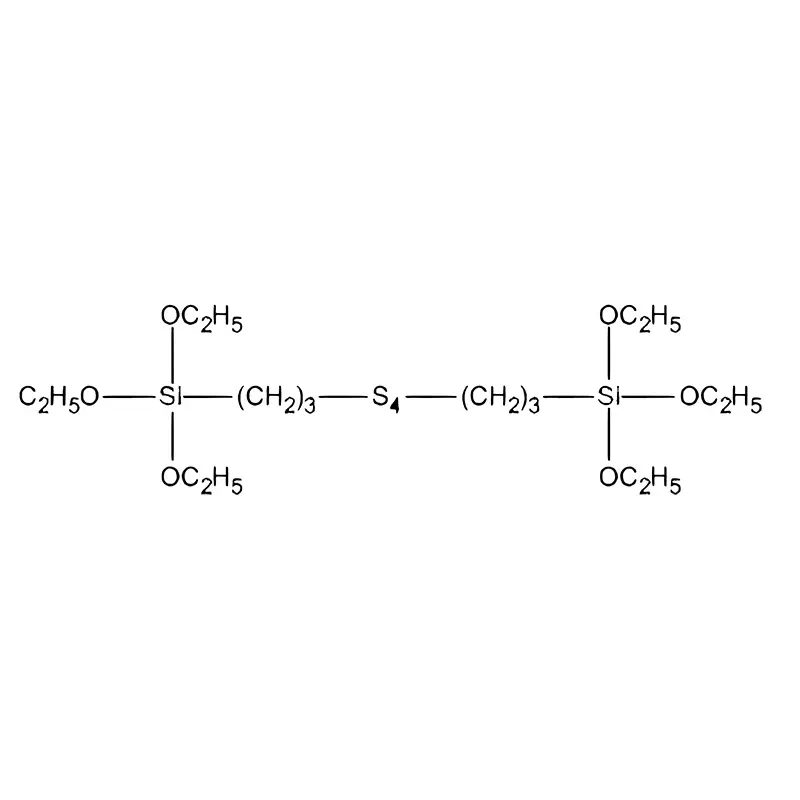
This product is a multifunctional silicone compound successfully used in the rubber and plastics industry. Its application improves the physical and mechanical properties of rubber, including tensile strength, tear strength, and wear resistance. It can significantly improve the tensile strength, reduce permanent modification, and also reduce the viscosity of the adhesive, improving processing performance.
It is particularly suitable for sulfide rubber systems with carbon white or silicate additives. Suitable fillers include carbon white, talc powder, clay, mica powder, and ceramics. Applicable polymers include NR, IR, SBR, BR, NBR, and EPDM.
A: It must be stored in a cool, dry place away from heat and open flames. The container must be kept tightly closed, as exposure to moisture will cause hydrolysis and polymer formation.
A: The standard packaging options are plastic drums of 5 kg, 25 kg, and 200 kg. Custom specifications can also be provided upon request.
A: In tires, it increases wear resistance, reduces hysteresis, increases the modulus of elasticity, maximizes adhesion, and improves processability, tread wear resistance, thermal cracking resistance, and overall layer adhesion.
A: For flat belts, it improves wear and vulcanization resistance, reduces cost by replacing carbon black with clay, and extends service life. For V-shaped belts, it enhances the modulus of elasticity, abrasion resistance, flex life, and reinforcement adhesion.
A: Suitable fillers include carbon white, talc powder, clay, mica powder, and ceramics. Applicable polymers include NR, IR, SBR, BR, NBR, and EPDM.
A: It improves tensile and tear strength, increases wear resistance, reduces permanent modification, and reduces adhesive viscosity to improve overall processing performance.
![Famous Bis-[3-(trimethoxysilyl)-propyl]amine CAS 82985-35-1 Products, Product](https://site.cdnfile.io/www.boctoksilicone.com/b7a8c47713f462756c9e61cb65cea17f300_300.webp)